1. Executive Summary
Siam Commercial Bank (SCB) and the SCBX Group are executing a bold transformation that fuses coaching-enabled agility with a scaled AI strategy.
Unlike organizations that fall into “Agile theater,” SCB has deliberately combined cultural change, systemic flow practices, and a modern AI-first operating model to drive measurable outcomes.
Key takeaways:
- Coaching & Leadership Development – SCB Academy built internal capability to shift leadership behavior, reinforce agility, and embed a learning culture.
- Data & AI Modernization – SCB migrated to a cloud-native data lake, adopted Databricks for unified analytics, and implemented high-value AI use cases such as ATM cash forecasting.
- Strategic North Star – SCBX aims to achieve 75% of revenue being AI-enabled by 2027–2028 and 100% workforce AI literacy by 2025.
For leadership teams and SMBs alike, the lesson is clear: coaching shifts the people system, AI strengthens the business system, and flow optimization bridges the two..
2. Context & Strategic Ambition
SCB faced pressures familiar to many organizations: shrinking margins, rising digital expectations, and fierce competition.
Leadership recognized that surface-level Agile adoption — frameworks implemented without systemic change — would not yield genuine outcomes.
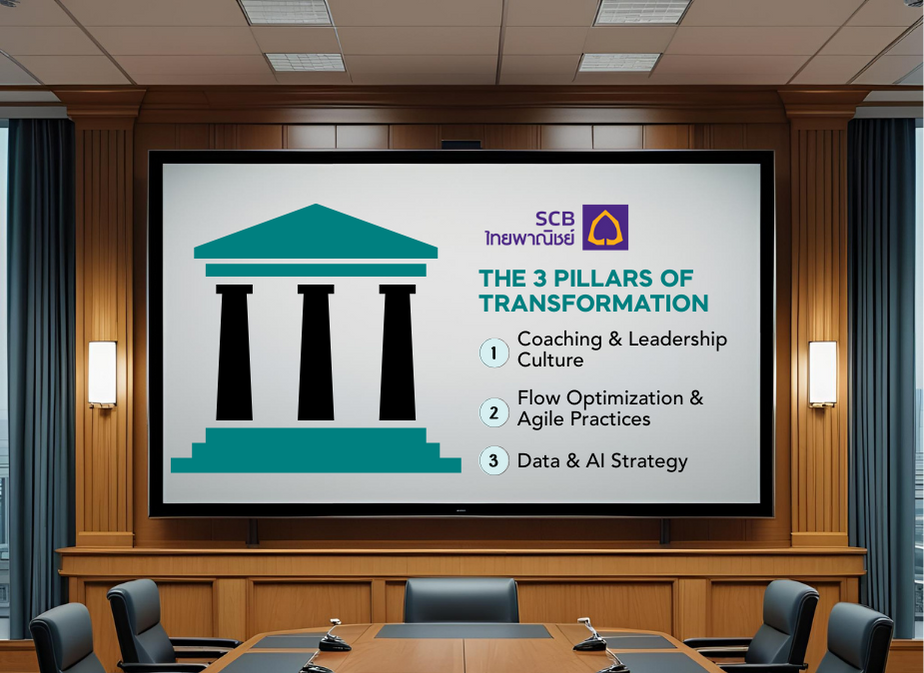
Instead, they anchored their transformation on three coordinated pillars:
- Coaching & Leadership Culture – Building leaders as coaches and empowering teams to take true ownership of outcomes, creating the foundation for a learning and adaptive organization.
- Flow Optimization and Agile Practices – Embedding systems thinking and flow-based metrics (cycle time, throughput, work-in-progress) to eliminate bottlenecks, reduce waste, and ensure value moves smoothly from concept to customer.
- Data & AI Strategy – Modernizing the data backbone with Azure and Databricks, while setting bold targets: 75% of revenue to be AI-enabled by 2027–28, and 100% workforce AI literacy by 2025.
3. Operating Model: Coaching-Enabled Agility
At the heart of SCB’s transformation lies coaching as infrastructure.
Through SCB Academy, leaders learned to act less as commanders and more as coaches – developing curiosity, facilitation skills, and systemic awareness.
Teams embraced cross-functional squads, visualized workflows, and adopted flow metrics (cycle time, throughput, work-in-progress). These practices strengthened predictability and created the psychological safety needed to innovate.
Agility, in this model, is not about stand-ups or rituals. It is about mindset, flow, and empowerment.
4. Data & AI Strategy: From Foundation to Flywheel
SCB complemented its cultural shift with a robust AI strategy.
Data Foundation: Migrated its data lake to Microsoft Azure – the first bank in Southeast Asia to achieve this milestone. This enabled scalable, governed access to data.
Unified Analytics Platform: Adopted Databricks to unify data, analytics, and AI workloads.
AI Use Cases:
- ATM Cash Forecasting – AI models optimize daily cash distribution, improving availability and reducing costs.
- Customer Personalization – Next-best-offer models improve customer relevance.
- Risk & Compliance – AI models detect anomalies and strengthen resilience.
Strategic Targets:
- By 2027–2028, ~75% of revenue is expected to be AI-enabled.
- And by 2025, the entire workforce is expected to be AI-literate.
5. Governance, Risk & Controls
SCB has also implemented model lifecycle governance, data security controls, and responsible AI practices to ensure regulatory compliance and maintain societal trust.
These include drift monitoring, explainability tooling, and clear escalation processes for high-risk models.
6. Business Outcomes

7. Systems Thinking & Flow Integration
SCB’s success lies in treating transformation as a system:
- Coaching accelerates behavioral change.
- Flow metrics reveal systemic bottlenecks.
- AI amplifies business decisions once reliable data and practices are in place.
This combination forms a flywheel of improvement:
- Coaching builds ownership.
- Flow practices reduce waste.
- AI leverages cleaner data for sharper insights.
- Continuous feedback loops compound results.
8. Playbook for Leaders & Decision Makers
8.1. Start with Culture & Flow
- Train leaders in coaching skills.
- Map one customer journey and measure cycle time, throughput, and the number of handoffs.
8.2. Build a Right-Sized Data/AI Foundation
- Deploy a cloud-based data store and define 2–3 “golden metrics.”
- Use a platform that allows rapid experimentation.
8.3. Sequence AI Use Cases by Value
- Cash/inventory forecasting.
- Personalized marketing.
- Risk detection.
8.4. Governance That Enables, Not Stifles
- Begin with a simple one-page “model card.”
- Set clear data ownership policies early.
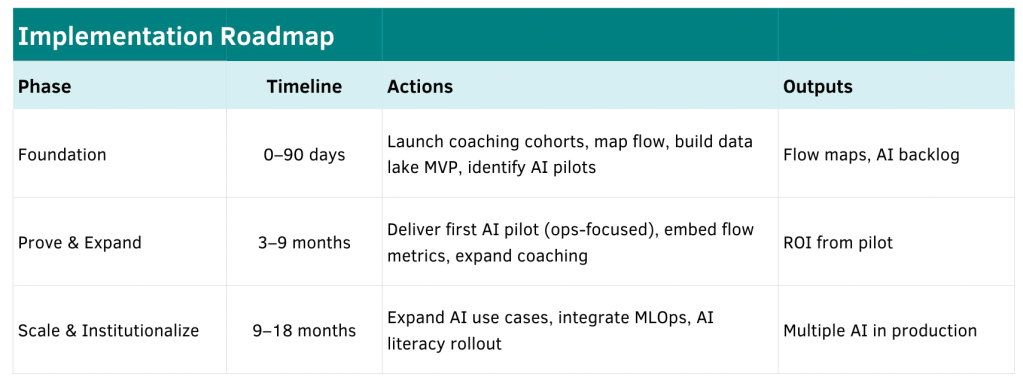
9. Potential Implementation Roadmap (12–18 Months)
10. Key Risks & Mitigation
- Agile theater: Mitigate with coaching, not ceremonies.
- Data sprawl: Use domain ownership and cataloging.
- PoC stagnation: Implement MLOps pipelines.
- Compliance risk: Ensure explainability and lineage tracking.
11. Lessons for Small Businesses
Even SMBs can apply this model:
- Start with leader-as-coach practices and lightweight flow reviews.
- Build a single data store and run a simple AI use case (inventory forecasting, churn prediction).
- Keep governance simple – enough to avoid surprises, yet not overly bureaucratic!
12. Conclusion
SCB/SCBX’s transformation underscores a powerful truth: agility without coaching collapses into rituals, and AI without flow collapses into chaos.
By combining coaching, flow, and AI, SCB has positioned itself to thrive in a volatile landscape. SMBs and large enterprises alike can borrow from this playbook:
- Start with humans
- Scale with data, then
- Reinforce with flow.
Coaching unlocks people, AI amplifies insight, and Flow ensures value moves without friction — together, they turn transformation into sustained impact.
–Fadly R. (Business & Leadership Coach)
References & Sources
- Accenture. Siam Bank Digital Transformation Case Study. Source.
- Databricks. SCB Accelerates Its Data + AI Transformation with Databricks. Source.
- Siam Commercial Bank. SCB Data Lake Evolution. Source.
- People Matters. The journey of becoming an agile workplace. Source.
- SCBX Press Release. AI Outlook 2025: 75% Revenue AI-Enabled by 2028. Source.
- Accenture Tech Vision SEA 2023. ATM Cash Forecasting in Banking. Source (PDF).
- World Economic Forum. AI in Financial Services – overview of AI applications, risks, and governance in banking. Source.